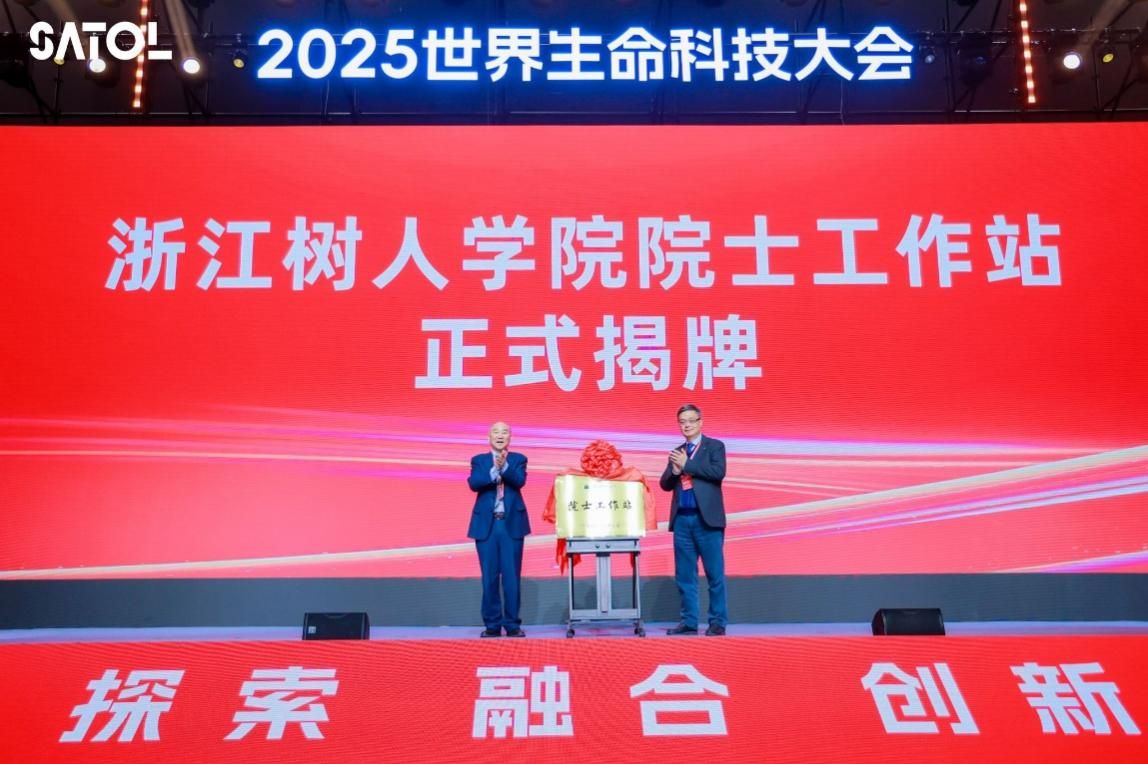
From December 5 to 7, the 2025 World Science and Technology of Life Conference, themed "Integration of Medicine and Engineering for High-Quality Chronic Disease Prevention and Control," was held in Hangzhou. In response to the "Healthy China 2030" strategy, the conference focused on the shift from a treatment-centric to a health-centric model. It sought to promote the convergence of biological, information, and medical technologies, and to establish an integrated system for the prevention, diagnosis, treatment, and rehabilitation of chronic diseases.
The conference brought together leading experts, scholars, and officials in life sciences and medicine from across Beijing, Shanghai, Zhejiang, Guangdong, Henan, the Hong Kong Special Administrative Region, the Macao Special Administrative Region, and Canada. At the opening ceremony, President Li Lu and Academician Zheng Shusen of the Chinese Academy of Engineering jointly unveiled Zhejiang Shuren University's Academician Workstation. This marks a crucial step forward in the university's development of high-end research platforms and its academician-led collaboration mechanism.
The workstation will form an interdisciplinary team dedicated to "research on key technologies for infectious diseases," targeting critical issues such as a precision-stratified diagnosis-and-treatment system for artificial liver support. Through fundamental research and clinical translation, it will strive to build a high-level platform for technological innovation, talent aggregation, and the transformation of industry-academia-research outcomes.
As one of the conference's co-organizers, the university actively mobilized its faculty and students to participate. More than 500 participants from Shulan International Medical College, Chongde College, and Chongzhi College attended the academic events of the main venue and various forums. Over 50 medical undergraduates provided reception and volunteer services, demonstrating their positive demeanor and professional competence.